


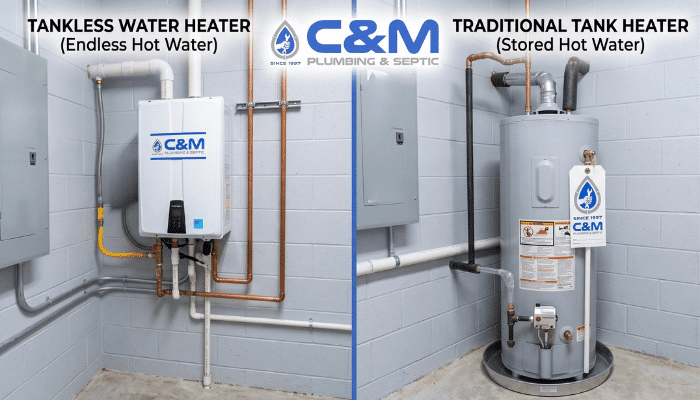
"Should I go tankless?" is one of the most common questions we get — and most of the answers online are the same generic checklist that could apply to a home in Arizona or Alaska. The real answer depends on where you live and how your home actually runs. So here's the version built for Eastern North Carolina.
Tankless water heaters heat water on demand, save space, and last longer, but cost more upfront and need adequate gas or electrical capacity. Traditional tank heaters cost less to install and keep a reserve of hot water. In Eastern NC, the right choice also hinges on local factors: well-water hardness (which scales tankless units faster), whether you have natural gas or propane, and how your home rides out storm-season power outages.
The basic trade-off
At a high level, the comparison is simple. Tankless units heat water only when you turn on the tap, so you get an endless supply and lower standby energy use, and they last longer and take up far less space — but they cost more to buy and install. Traditional tank heaters are cheaper upfront and keep a ready reserve of hot water, but that reserve is finite and the units wear out sooner. Here's how it breaks down:
| Factor | Tankless | Traditional Tank |
|---|---|---|
| Upfront cost | Higher to buy and install | Lower upfront |
| Typical lifespan | 15–20+ years | 8–12 years |
| Hot water supply | Endless, heated on demand | Limited to tank size |
| Space needed | Compact, wall-mounted | Large floor-standing unit |
| During a power outage | Usually no hot water (needs power to ignite) | Standing-pilot gas tanks may still work |
| Well / hard water | Scales faster; best paired with treatment + periodic descaling | More forgiving, but still benefits from treatment |
| Energy use | Heats only when you need it | Reheats to keep the tank warm |
| Best fit for | Space-tight or natural-gas homes with high hot-water demand | Lower budgets, outage-prone areas, rural propane/electric homes |
That's the standard picture. Now here's what actually tips the decision in our area.
Local factor #1: your water
This is the big one, and it's the factor those generic articles skip. A large share of Eastern NC homes — especially rural Wayne County — run on well water that's hard and often carries sediment and iron. Tankless units are more sensitive to that than tank models: minerals scale up the heat exchanger and can choke efficiency or trip errors, and many tankless warranties actually require softening or annual descaling. If you're leaning tankless on well water, plan on pairing it with water filtration — otherwise you may spend the savings on maintenance.
Local factor #2: your fuel
Natural gas isn't available everywhere out here. Plenty of rural homes run on propane or electric, and that changes the math — electric tankless units draw serious amperage and may need a panel upgrade, while propane adds ongoing fuel cost. What makes sense in town isn't automatically what makes sense a few miles out.
Local factor #3: storm season
We get hurricanes, and we get power outages. Here's what surprises people: most tankless units — even gas ones — need electricity to ignite and run, so when the power's out, so is your hot water. Some older standing-pilot tank heaters will still give you a tank's worth of hot water through an outage. If riding out storms matters to you, that's a genuine point in the tank column.
So which is right for you?
Tankless tends to win for homes tight on space, on natural gas, with high hot-water demand and water treatment already in place. A traditional tank often makes more sense for a tighter upfront budget, outage-prone locations, or rural propane/electric homes on untreated well water. Neither is "better" — they're better for different homes. Keeping an eye on either one is worth it; our guide on spotting a water heater problem before it fails helps you stay ahead of a cold-shower morning.
The best way to decide is to have someone look at your actual setup — your water, your fuel, your panel, your household's demand. We install and service both traditional water heaters and tankless systems across Eastern NC, and we'll tell you honestly which one fits your home — not which one we'd rather sell.