

A Backflow Testing Guide for Wayne County Homeowners & Businesses
If you've got an irrigation system, fire sprinklers, or a commercial property in Eastern NC, you've probably gotten a notice from your water authority about backflow testing — and if you haven't yet, you likely will. Most municipalities across the region require annual testing to keep your device compliant, and missing that deadline can mean fines or a compliance letter you didn't want.
The good news: testing is quick, straightforward, and easy to stay ahead of once you know your schedule.
Why is backflow testing required in the first place
A backflow preventer's job is simple but important: keep used, non-potable water from flowing backward into the clean water supply. Without a working device, contaminated water from irrigation systems, fire sprinklers, or commercial equipment could siphon back into the drinking water system, which is exactly why local water authorities require it.
That's the reasoning behind our backflow prevention services: it's not paperwork for paperwork's sake, it's protecting the water supply for everyone on the line.
How often does a backflow device need to be tested?
Most backflow devices require testing once a year. That said, the exact requirement can vary by:
- Your specific water authority or municipality
- Whether the property is residential, commercial, or has fire protection
- The type of device installed (RPZ assembly, double check valve assembly, pressure vacuum breaker, etc.)
Many water authorities in Eastern NC send an annual reminder notice — but don't wait for the mail. If it's been close to a year since your last test, it's worth getting ahead of it.
What happens during a backflow test
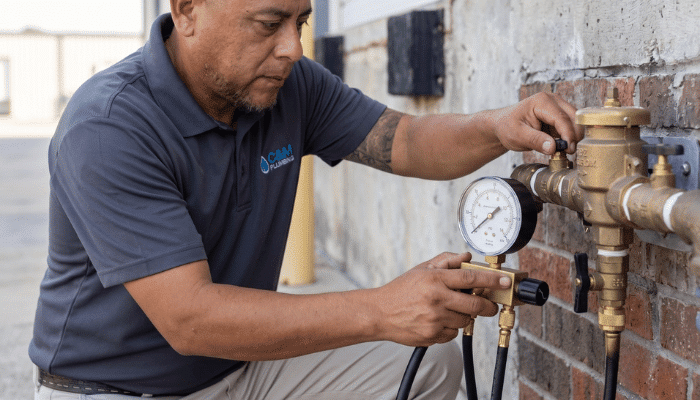
A typical test appointment is fast and low-hassle:
- A certified technician connects testing gauges to your device
- The device is checked to confirm it's preventing backflow correctly
- Results are documented and, in most cases, submitted directly to your water authority
- If the device passes, you're done until next year
If it doesn't pass, that's not automatically bad news — see below.
What if my device fails the test?
A failed test doesn't always mean a full replacement. A repair-first technician will diagnose the issue and determine whether it can be fixed safely and affordably. If it can, the device gets repaired and re-tested on the same visit to confirm it now meets standards. If not, replacement is the next step — and the new device is tested before the job is considered complete. Our backflow repair and replacement page covers common causes of failure in more detail.
Do you need installation instead of testing?
If you're building new, adding an irrigation system, or bringing an existing property up to code, you'll need a device installed before it can ever be tested. Our backflow installation page walks through the devices we install and how the estimate process works.
Quick answers: backflow testing FAQs
Yes — both are common triggers for backflow requirements, along with standard commercial and residential plumbing.
Not with us. Testing includes full documentation, and in most cases it's submitted directly to your water authority on your behalf.
Typically within a few business days of your call.
Proudly Serving Wayne County & Eastern North Carolina Since 1997
C&M Plumbing & Septic has provided certified backflow testing, installation, and repair throughout Mount Olive, Goldsboro, Wilson, Greenville, Newton Grove, and the rest of Eastern NC since 1997. One team handles the whole job — testing, installation, and repair — with fast scheduling and no runaround.
Stay Ahead of Your Backflow Compliance Deadline
Don't wait for a notice in the mail. Call 919-658-6109 or schedule your backflow test online today. We're open Monday–Thursday 7:00am–5:00pm and Friday 7:00am–4:00pm.