


When Old Pipes Start Costing You More Than They're Worth
You turn on the shower and the water comes out in a weak, uneven stream. You run the kitchen tap first thing in the morning and there's a rusty tint to it. Maybe you've had the same stretch of pipe patched twice in the last year, and you're starting to wonder if you're throwing good money after bad.
Around here, that's usually the pipes telling you something. A lot of the homes we work on across Wayne County and Eastern North Carolina have been standing for decades, and the plumbing inside the walls has been quietly aging the whole time. The good news is that the warning signs are easy to spot once you know what you're looking at — and catching them early can save you from a burst pipe and a flooded floor down the road. Here are five of the most common.
Why Older Homes Around Here Are Prone to Pipe Trouble
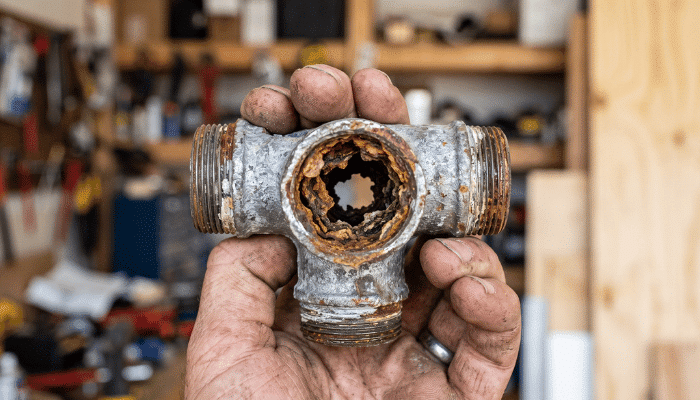
If your home was built before the mid-1990s, there's a real chance it was plumbed with galvanized steel or polybutylene — two materials that don't hold up the way modern piping does. Galvanized pipe corrodes from the inside out, slowly choking off your water flow. Polybutylene, which was used heavily in the '80s and early '90s, becomes brittle over time and is prone to failing without much warning. Even older copper has a lifespan. Knowing what's in your walls is half the battle, and it's a big part of what our team looks at when we talk with homeowners about whole-home repiping.
Sign 1: Discolored or Rusty Water
If your water comes out brown, yellow, or tinted with rust — especially when you first turn on a tap that hasn't run in a while — that's corrosion flaking off the inside of your pipes. A little discoloration once in a blue moon can happen, but if it's regular, your pipes are breaking down internally.
Sign 2: Leaks That Keep Coming Back
One leak is a repair. Leaks that keep showing up in different spots are a pattern — and the pattern is aging pipe. Pinhole leaks in particular tend to travel, because once a line starts corroding in one place, the rest of it usually isn't far behind. If you're chasing leaks around the house, or you suspect one you can't see, our professional leak detection can pinpoint exactly what's going on before you commit to anything.
Sign 3: Low or Uneven Water Pressure
When mineral buildup and corrosion narrow the inside of your pipes, less water can get through. If your pressure has dropped off gradually, or if it drops hard whenever someone flushes a toilet or starts the washer, restricted pipes are a likely culprit.
Sign 4: You Have Polybutylene or Galvanized Pipe
This one's less a symptom and more a fact worth knowing. If you can confirm your home has polybutylene or galvanized supply lines, repiping is usually a matter of when, not if — and doing it on your schedule beats doing it after a 2 a.m. failure.
Sign 5: Water That Tastes or Smells Metallic
A metallic taste or smell often points back to the same corrosion causing the discoloration. If your water tastes like it's been sitting in an old can, your pipes may be the reason.
Repair or Repipe? We'll Give It to You Straight
Not every one of these signs means you need a full repipe — sometimes it's a single bad section, and that's all we'll recommend. We've been doing this since 1997, and we won't upsell you into a job you don't need. If a repipe is the right call, we'll walk you through the whole thing, and we offer flexible financing so it doesn't have to hit all at once.
Seeing one or more of these signs at your place? Call C&M Plumbing & Septic at 919-658-6109 or schedule service online, and we'll take a look and tell you honestly where you stand.